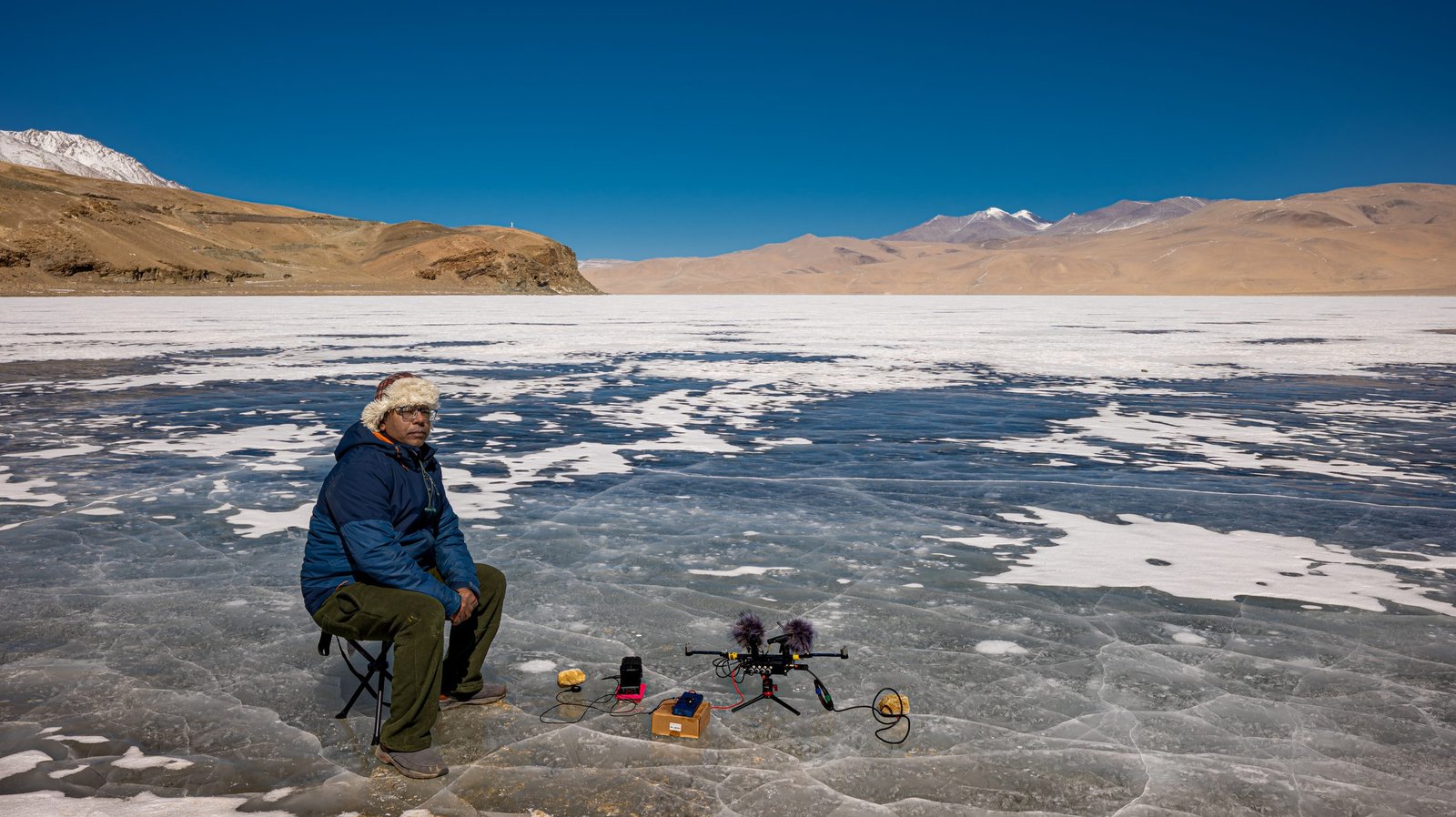
When recording sounds in the field, choosing the right microphone is only half the equation. How the microphone receives sound from different directions—the polar pattern—is equally important.
In a forest, wetland, mountain valley or coastal environment, sound rarely comes from one direction. Birds may call from the canopy, insects may surround the recorder, wind may arrive from behind, while distant traffic or human activity may enter from the horizon.
Understanding microphone polar patterns allows a field recordist to control what is captured, what is rejected, and how natural the resulting soundscape feels.
What Is a Microphone Polar Pattern?
A microphone’s polar pattern describes its sensitivity to sound arriving from different directions around the microphone.
Imagine placing the microphone at the centre of a circle. A polar-pattern diagram shows how sensitive the microphone is as you move around that circle.
The most important patterns for field recording are:
- Omnidirectional
- Cardioid
- Supercardioid
- Hypercardioid
- Bidirectional / Figure-8
- Shotgun / interference-tube microphones
Each pattern creates a different relationship between the recorder and the surrounding environment.
1. Omnidirectional Microphones
An omnidirectional microphone is designed to capture sound from all directions relatively evenly.
The polar pattern is approximately circular.
Best applications
Omnidirectional microphones are particularly useful for:
- Natural soundscapes
- Forest ambience
- Wetlands
- Rain
- Rivers and streams
- Insects
- Wind and environmental textures
- Geophony
- Long-duration passive acoustic monitoring
- Immersive ambience
For example, if you are recording a wetland soundscape, you may want to hear birds from different directions rather than pointing the microphone toward one particular bird.
Advantages
Natural spatial response
Omnidirectional microphones can produce a very open and natural representation of the environment.
Good low-frequency response
Many omnidirectional microphones have excellent low-frequency characteristics, which can be useful for recording:
- Thunder
- Rivers
- Distant vehicles
- Wind
- Large animals
- Geophysical sounds
Less proximity effect
Compared with directional microphones, omnis generally have much less proximity effect.
Limitations
The microphone does not strongly reject sounds coming from behind or the sides.
Therefore, an unwanted road, generator, aircraft or nearby conversation can become part of the recording.
Ideal field-recording situation
If you are sitting quietly in a forest and want to document the entire acoustic environment, an omnidirectional pair can be one of the best choices.
2. Cardioid Microphones
A cardioid microphone is most sensitive to sound arriving from the front and progressively rejects sound from the rear.
Its pattern resembles a heart, hence the name.
Best applications
Cardioids are useful when you want to focus on a particular acoustic area:
- Bird calls
- Animal activity
- Waterfalls
- Insects
- Cultural performances
- Human activity
- Specific environmental sources
- Stereo ambience
- Interviews in outdoor environments
A cardioid can help reduce unwanted sound from behind the microphone.
Example
Suppose you are recording birds beside a forest road.
With an omni microphone, traffic behind you may become a major part of the recording.
With a cardioid microphone pointed toward the forest, the microphone can provide greater rejection of the road behind you.
However, it will not eliminate the traffic completely.
3. Supercardioid
A supercardioid microphone has a narrower front pickup area than a standard cardioid.
It also has a small area of sensitivity directly behind the microphone.
Useful for
- Wildlife
- Bird recording
- Focused environmental sounds
- Outdoor interviews
- Documentary production
- Distant sound sources
- Recording specific acoustic events
The narrower pickup makes it easier to isolate a particular source.
However, positioning becomes more critical.
A small change in microphone direction can significantly change the recording.
4. Hypercardioid
Hypercardioid microphones provide an even narrower forward pickup pattern.
They also have a stronger rear lobe than cardioid microphones.
This makes microphone orientation particularly important.
Useful for
- Wildlife recording
- Bird calls
- Specific sound sources
- Documentary sound
- Noisy environments
- Isolating subjects from surrounding ambience
Hypercardioid microphones can be extremely useful when you know exactly where your sound source is located.
But they are less suitable when your goal is to capture an entire natural soundscape.
5. Figure-8 / Bidirectional Microphones
A figure-8 microphone captures sound primarily from the front and rear, while rejecting sound from the sides.
This pattern is especially interesting for advanced stereo recording.
One of the most important applications is Mid-Side (M/S) recording.
M/S configuration
A typical M/S setup uses:
- One cardioid or hypercardioid microphone as the Mid
- One figure-8 microphone as the Side
The resulting signal can be decoded into stereo.
Why M/S is useful in field recording
M/S allows you to adjust the stereo width during post-production.
This is extremely useful for documentary filmmaking because you can create a relatively narrow stereo image for dialogue or focused sounds, or widen the ambience for environmental sequences.
6. Shotgun Microphones
Shotgun microphones are commonly used for highly directional recording.
They use an interference tube to increase rejection of sound arriving from off-axis directions.
They are widely used in:
- Wildlife documentaries
- Bird recording
- Film production
- Outdoor dialogue
- Animal behaviour documentation
- Distant sound sources
A shotgun microphone is not simply a “more powerful” microphone.
Its main advantage is directionality.
Important limitation
A shotgun microphone does not magically remove unwanted sounds.
In a forest, for example, a road behind the microphone may still be audible.
The microphone’s off-axis response, reflections, wind and surrounding acoustics all affect the final recording.
Polar Pattern vs Stereo Configuration
It is important to distinguish between polar pattern and stereo microphone technique.
Polar pattern describes how the microphone responds to direction.
Stereo configuration describes how microphones are arranged to create a stereo image.
Common field-recording configurations include:
AB / Spaced Omnis
Two omnidirectional microphones are placed apart from each other.
Excellent for:
- Forest ambience
- Wetlands
- Rivers
- Rain
- Large soundscapes
- Immersive environmental recording
ORTF
Two cardioid microphones are arranged with a specific angle and spacing.
ORTF provides a convincing stereo image while maintaining reasonable compatibility and localization.
Excellent for:
- Nature ambience
- Documentary sound
- Outdoor environments
- General-purpose stereo recording
XY
Two directional microphones are positioned closely together with their capsules angled relative to each other.
Advantages include:
- Good mono compatibility
- Stable stereo image
- Compact setup
- Easy deployment
Mid-Side
A Mid microphone and figure-8 Side microphone provide a flexible stereo recording that can be adjusted during post-production.
This can be particularly valuable in documentary production.
Which Polar Pattern Should You Use?
| Recording Objective | Recommended Pattern |
|---|---|
| Complete forest soundscape | Omni |
| Wetland ambience | Omni / AB |
| Rain | Omni |
| River and waterfall ambience | Omni / Cardioid |
| Bird from a known direction | Supercardioid / Hypercardioid / Shotgun |
| Distant wildlife | Shotgun |
| General environmental ambience | Cardioid / Omni |
| Outdoor interview | Cardioid / Supercardioid |
| Stereo documentary ambience | ORTF / XY / M/S |
| Immersive natural ambience | Spaced omnis |
| Sound source isolation | Hypercardioid / Shotgun |
| Experimental soundscape | Omni + contact/geophone combinations |
Polar Patterns and Wildlife Recording
Wildlife recording presents a special challenge.
The objective is often not simply to record the animal.
You may also want to document:
- The animal’s acoustic environment
- Other species responding to it
- Distance and direction
- Habitat ambience
- Insects
- Wind
- Water
- Human disturbance
This is where choosing between directional and omnidirectional microphones becomes important.
For a species documentation project, I would consider using two recording layers:
Layer 1 — Focused recording
Use a directional microphone to capture the target species.
Layer 2 — Environmental recording
Use omnidirectional microphones to capture the surrounding soundscape.
Together, these recordings provide much more ecological information than either microphone alone.
Polar Patterns and Ecoacoustics
For ecoacoustic research, microphone selection can affect the acoustic data itself.
A highly directional microphone may emphasize a particular sound source while reducing other components of the soundscape.
An omnidirectional microphone can provide a broader representation of the acoustic environment.
Therefore, when comparing recordings between locations or dates, consistency is extremely important.
Try to maintain the same:
- Microphone model
- Polar pattern
- Height
- Orientation
- Recorder
- Gain structure
- Recording format
- Sampling rate
- Recording duration
- Deployment methodology
This is particularly important when calculating acoustic indices or comparing biodiversity over time.
A Practical Field-Recording Setup
For a serious nature sound-recording expedition, a versatile setup could include:
Setup A — Soundscape
Two matched omnidirectional microphones
Use for:
- Forest ambience
- Wetlands
- Mountain valleys
- Rain
- Rivers
- Night soundscapes
Setup B — Wildlife
One directional microphone
Use for:
- Birds
- Mammals
- Amphibians
- Insects
- Specific behavioural events
Setup C — Documentary
Shotgun + stereo ambience
Use the shotgun for the primary subject and stereo microphones for environmental sound.
This gives you flexibility during editing.
Don’t Forget Wind Protection
Polar pattern is only one part of outdoor recording.
Wind can destroy an otherwise excellent recording.
Every serious field-recording setup should consider:
- Foam windshield
- Fur windshield
- Blimp/wind basket
- Shock mount
- Proper microphone suspension
- Low-cut filtering where appropriate
- Physical protection from rain
For wildlife and environmental recording, wind management can be just as important as microphone selection.

Leave a Reply